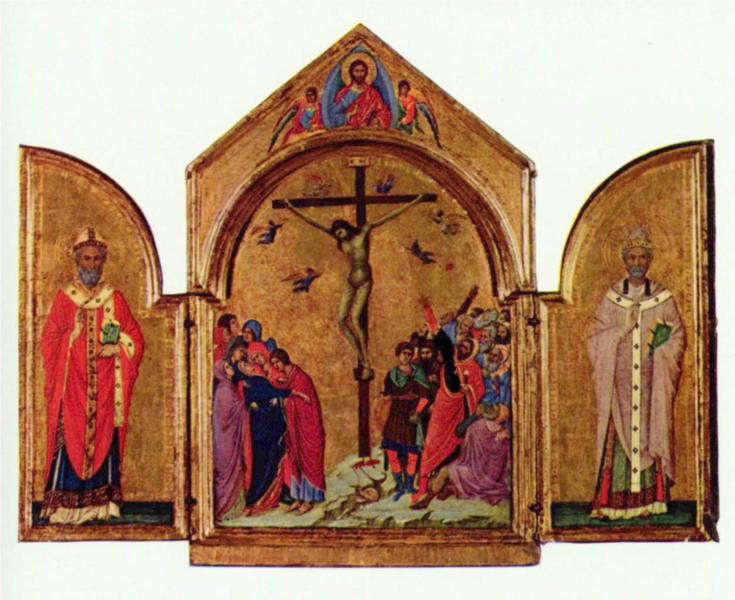
Christ Crucified

crucifixion-triptych

When viewing an image of Christ crucified, the physical sufferings of Christ are evident.  He is typically portrayed in agony.  His body physically distorted.  His wounds gruesomely depicted in great detail.   Commentaries have described the brutality of His crucifixion in great detail.   The image of Christ crucified and commentaries assist in meditating on His great sacrifice.

In addition to His physical sufferings, Christ suffered mental anguish, as seem in His prayer on the Mount of Olives.   Judas Iscariot has betrayed Him, and His remaining disciples are beginning to abandon Him, for they cannot remain awake to pray with Him.

When I meditate upon Christ crucified, I meditate upon the mental anguish He suffered.  This is how I unite myself with His sufferings.  I unite the pain I have endured from betrayal and abandonment by loves ones who I loved and trusted.  Such betrayal and abandonment pierces the heart, chills the marrow, and mortifies the spirit.

When I envision Christ crucified, I envision Him looking down from the cross.  Of the twelve, He sees only John.  The other eleven who He shared the three years of His ministry with, who swore their allegiance to Him, who He had placed His trust in, are nowhere to be seen.   The betrayal and abandonment by His disciples must have pained Him as much as the nails that pierced His hands and feet.

The pain Christ bore on the cross was the pain of sin. I see my sin as betrayal of Christ, an abandonment of Him.  This is also how I see the eternal agony I will endure, if I do not repent from my sin.  My sinful abandonment of Christ separates me from him.  This is when I call upon him, ask for forgiveness in His great sacrament of reconciliation, and enjoy the great joy of His mercy and returning to Him.

Posted in Uncategorized | Tagged , , , , , , | 2 Comments

As Wise as Pigeons: Lessons Never Learned | Crisis Magazine

Follow this link to another great essay by Professor Anthony Esolen: As Wise as Pigeons: Lessons Never Learned | Crisis Magazine.  In his essasy, Professor Esolen covers many issues facing society and the Church. I hope you also find it a worthwhile read.

Posted in This & That, Uncategorized | 3 Comments

The Hallow Effect

The hallow effect is a marketing phenomenon that I believe can benefit the spiritual life.  So, what is the “hallow effect?”   It is best understood though an example.  A shampoo is typically tested marketed containing difference fragrances to determine which fragrance is more pleasing to consumers.  The shampoo containing the most pleasing fragrance is typically found to leave hair more manageable, shiny, bouncy, etc. than the others having the same shampoo but lesser pleasing fragrances.  This is the hallow effect, that which is more sensually pleasing is perceived to be more functionally beneficial.

How can the hallow effect benefit the spiritual life? Is this not how we try to rationalize sin?  We try to convince ourselves in believing that which brings more sensual pleasure is more functionally beneficial and practical.  How is it a sin, when such a great benefit is achieved?  Birth control and abortion are “marketed” as being functionally beneficial and practical, as are cohabitation and so-called same sex marriage.  Less serious sins are similarly rationalized.

In examining our conscious, we need to look beyond our inner self and our rationalization of our behavior.   We need ask, what truly motivated our sinful behavior?  Is not most sin a result of satisfying self?  “The Son of man came not to be served but to serve” (Matthew 20:28).  We called to do the same, to serve others and God and not self.

Posted in Essays, Meditations On Biblical Verses, Uncategorized | Tagged , , , , , , , | 2 Comments

Desire in Prayer

Our heart’s desires are released in prayer.  How are the desires of our heart expressed?  Are they expressed in a multitude of words?  Are they expressed as desires for earthly treasures?  Or, is the desire of our heart expressed as a total surrendering of our will to God?

A surrendering of our will requires a release of self-love for the love of God.  Our prayer of surrender is a plea to bare all and endure all for the God.  The Holy Spirit will enkindle a fire of love of God within our heart and stoke the flames of that fire to refine and purify our love of God.   When surrendered to Christ, the crosses we carry, the humiliations we bare for Christ, our earthly desires that burden us, and the self-love that weighs us to this world can fuel the flames that refine and purify our love of God.

Posted in Essays, Uncategorized | Tagged , , , , , , , , , | 2 Comments

Leave Us Alone. Let Us Serve the Egyptians.

In today’s reading we heard the Israelites complaint to Moses: “Why did you do this to us?  Why did you bring us out of Egypt? Did we not tell you this in Egypt, when we said, ‘Leave us alone.  Let us serve the Egyptians.’ Far better for us to be the slaves of the Egyptians than to die in the desert.”  (Exodus 14:11-12)

The path of following the Lord appears hard to us. We hold onto the comfort of our slavery to money, power, prestige, and sensual pleasures.   It is part of our human nature, our human struggle.  We fear the act of surrendering to the Lord.  We want to be in control of our destiny.

We do not want to acknowledge that God has provided us what we have.  Whatever we possess (be it one dollar or billions of dollars) is nothing in comparison to what the Lord offers to those who surrender themselves to him. The Lord calls us to follow him, but like the poor rich man, we turn our backs, tell the Lord, “Leave me a alone,” and walk away sad and fearful of giving up what we have for a far getter treasure.

The Lord remains ever faithful to his promise.  We too must remain faithful and hope with endurance.  Like the wondering of the Israelites in the desert or those who followed Christ on His journey to Calvary, our journey with the Lord may be long, the pathway filled with challenges and hardships, the rewards glorious and eternal, and filled with awe, wonder, miracles and encounters with Lord God.

Posted in Essays, Meditations On Biblical Verses, Uncategorized | Tagged , , , | Leave a comment

The Sign of the Cross

The sign of the cross, one of our most profound and simplest forms of prayer, is falling out of favor among many Catholics.  It is ancient prayer, dating back to the earliest years of our faith.  Tertullian (De cor. Mil. iiii) commented, “In our coming in and going out … we mark our foreheads with the sign of the cross.”   And, St. Cyril of Jerusalem remarks in his Catecheses (xiii, 36) “let us then not be ashamed to confess the Crucified. Be the cross our seal, made with boldness by our fingers on our brow and in every thing; over the bread we eat and the cups we drink, in our comings and in goings; before our sleep, when we lie down and when we awake; when we are travelling, and when we are at rest.”

For most of us, it is the first prayer we learned.  Through this simple prayer we learned of Christ crucified and the holy trinity.   In repeating the words: “In the name of Father, Son, and Holy Spirit” we commemorate our baptism.  In the physical action of crossing ourselves we designate (mark) that we belonging to the God.

We should not shy away from making the sign of the cross.  Christ boldly mounted the cross and suffered profound agony for us.   We can witness to this fact through a simple, but powerful gesture.  If we are embarrassed or ashamed to make the sign of cross in public when we pray, image how embarrassed or ashamed we will feel when we stand before Christ at the moment of our death.

Posted in Essays, Uncategorized | Tagged , , , , , , | 6 Comments

To Walk with Those Who Walked Before

As a child I would ask God why He chose to have me live in such an uneventful period of salvation history.  I yearned to have lived in the times of Jesus.  Or, at least to have lived during the period of St. Francis of Assisi or one of the other great saints of the church.

The periods when Christ and His Saints Polycarp, Francis of Assisi, Teresa of Avila, and Thérèse de Lisieux walked the earth were important periods in salvation history.  I would ask where are the saints of this age?  Why am I living in such an unimportant period of salvation history?

In every age, God calls and desires His people to be united with Him.  In each age, the Lord raises up great saints.  We are living in an important period of salvation history.  We are living in a period filled with many great saints.  All are called to be faithful; all are called to render onto God what is God’s; all are called to serve the Lord.  We are all called to be saints, to face the challenges and battles the Lord has set before us.  We, like those who walked before, are called to walk with the Lord.

Posted in Essays, Uncategorized | Leave a comment

I Drew Him Out of the Water

When the child grew, she brought him to Pharaoh’s daughter, who adopted him as her son and called him Moses, for she said, “I drew him out of the water.” (Exodus 2:10)

Pharaoh feared the Hebrews.  He had Hebrew baby boys drowned in the waters of the Nile.  For Moses, the Nile did not bring death.  His “baptism” in the waters of the Nile brought forth new life.

God commissioned Moses to bring new life to his Nation by drawing the Hebrews out of Egypt.  Those baptized in the Father, Son, and Holy Spirit are commissioned by Christ to bring new life to their Nation and family, by announcing the Good News of the Kingdom of God.  Baptism brings, in addition to a personal relationship with God, a relationship with all of God’s people, especially His lost sheep. The baptized are called to drawn the lost sheep out of the wilderness, back to their Shepherd, Christ Jesus.

Posted in Essays, Meditations On Biblical Verses, Uncategorized | Tagged , , , , , , , , , , , , , | Leave a comment

Proverbs and the Eucharist

“Let whoever is simple turn in here!” To him who is without sense she says, “Come, eat of my bread and drink of the wine I have mixed.” The fear of the Lord is the beginning of wisdom, and the knowledge of the Holy One is insight.” (Proverbs 9:4-5, 10)

Oh, the comfort that the Holy Eucharist brings – grace without bounds, peacefulness of body and soul.  Christ rains down sweet love in the Eucharist!

The wonderful insights Christ reveals through His Eucharist presence.  The beautiful truth He plants in the hearts of those who encounter Him in the Eucharist.  His truth produces knowledge and wisdom in simple of heart.

Posted in Eucharist, Meditations On Biblical Verses, Uncategorized | Tagged , , , , , , | Leave a comment

Marriage, Abortion, the Holy Spirit, and the Church

The Bible begins with a wedding and ends with a wedding reception.  Genesis, the first book of the Bible opens with a marriage, the wedding of Adam and Eve and God’s command to the couple to be fruitful and multiply.  The Bible concludes with the Book of Revelation and the wedding feast of the Lamb of God to His bride, the Church.   The Bible is rife with marriage imagery and the fruit it bares, love and life.

Out of love, God created man and woman.  The depth of God’s love for His people and Church is expressed in terms of the love shared between a husband and wife.  As a husband and wife surrender themselves to one another, God invites us to surrender ourselves to Him in love.  Similarly, our unfaithfulness to God is expressed in terms of spousal infidelity.

The Holy Spirit is the love flowing between the Father and Son.  As members of the Christ’s Body, the Church, the Holy Spirit draws us into the love shared between the Father and Son.  Spousal love between a man and a woman mirrors the love shared between the Father and Son.  Further, the product of spousal love, children, reflects God’s creative love.  Contraception blocks the full expression of spousal love.  Abortion is destroys the product of spousal love.

This is why the evil one continually denigrates marriage and all that it represents and produces.  Satan wants to destroy the marriage covenant between a man and a woman because it is an earthly representation of the covenant between Christ and His Church.  Satan promotes contraception because conception blocks the full expression of spousal love and its ability to participate as co-creators with God.  The creation of life is the product of God’s love; this is why Satan desires the bloody sacrifice of children through abortion.

Posted in Essays, Uncategorized | Tagged , , , , , , , , , | 4 Comments