Purgatory in the Old Testament and Early Church

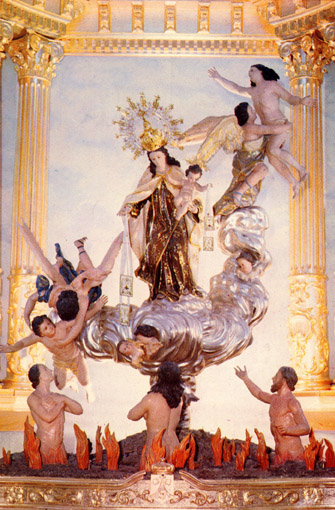
Purgatory FolioI will conclude this week’s brief (unplanned, but is this not how the Lord works) discourse on Purgatory with The Roots of Purgatory which presents further Biblical support for Purgatory.  The early Church Fathers teachings on the Purgatory is also briefly presented in this wonderful essay.

God slowly unveils the mystery of Purgatory in Old Testament, Christ preached it, it is further  expounded on by the Apostles in their Epistles, and the early Church Fathers taught it.  It can be clearly seen that Purgatory is firmly and unambiguously rooted in the Old and New Testaments.  Moreover, it was taught from the very beginning of the Church.

Posted in Essays, Uncategorized | Tagged , , , , , , , , , , , , , , , , | Leave a comment

Yes Virginia, There Is a Purgatory

PurgatoryMy recent postings referencing Purgatory have prompted some to ask, where does Purgatory appear in the Bible?   St. Paul wrote in Greek.   When St. Paul stated that, “he himself will be saved, but only as through fire,” (1 Corinthians 3:15) Paul used the Greek word puros to describe the fire.   The English word Purgatory comes from this puros.  In other words, Purgatory is the place where puros (the saving purifying fires) burn.

Besides 1 Corinthians 3:13-15, the purifying fires of Purgatory are described in:

Jesus said to the multitudes “I tell you, you will never get out till you have paid the very last copper.” (Luke 12:59 – full discourse Luke 12:42-59) – all residues of sin must be removed.

“Now I rejoice in my sufferings for your sake, and in my flesh I complete what is lacking in Christ’s afflictions for the sake of his body, that is, the church” (Colossians 1:24) – we are to rejoice at purification we must endure for glory to dwell with the Lord.

“And have you forgotten the exhortation which addresses you as sons? — “My son, do not regard lightly the discipline of the Lord, nor lose courage when you are punished by him. For the Lord disciplines him whom he loves, and chastises every son whom he receives.”  It is for discipline that you have to endure. God is treating you as sons; for what son is there whom his father does not discipline?  If you are left without discipline, in which all have participated, then you are illegitimate children and not sons.  Besides this, we have had earthly fathers to discipline us and we respected them. Shall we not much more be subject to the Father of spirits and live?  For they disciplined us for a short time at their pleasure, but he disciplines us for our good, that we may share his holiness.   For the moment all discipline seems painful rather than pleasant; later it yields the peaceful fruit of righteousness to those who have been trained by it.” (Hebrews 12:5-11)  — the Lord disciples us in this life and the life that follows.

“To the assembly of the first-born who are enrolled in heaven, and to a judge who is God of all, and to the spirits of just men made perfect” (Hebrews 12: 23) – those who attain heaven will be made perfect.

Yes, Purgatory is described in the Bible.  Purgatory cannot be denied.  It should not be feared.  It should be rejoiced for, for through it we will be made pure to be united with Christ forever.

Posted in Essays, Meditations On Biblical Verses | Tagged , , , , , , , , , , , | 9 Comments

Mary, the Queen Mother of the Davidic King Who Reigns Forever

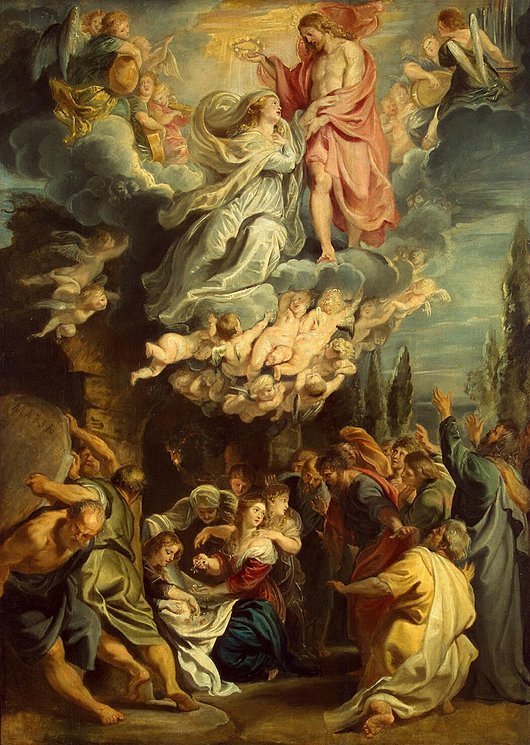
The Coronation of MaryJesus is of the line of King David, the fulfillment of God’s promise to King David: “When your days are fulfilled and you lie down with your fathers, I will raise up your offspring after you, who shall come forth from your body, and I will establish his kingdom. He shall build a house for my name, and I will establish the throne of his kingdom for ever.” (2 Samuel 7:12-13)  Christ Jesus is the promised Davidic King to reign forever.

Each of the Davidic Kings following King David reigned, not with his wife as Queen, but his mother.  To the right hand of the King sat the Queen Mother. The Queen mother had an influential role, as evidenced in King Solomon’s Court: “So Bathshe’ba went to King Solomon, to speak to him on behalf of Adoni’jah. And the king rose to meet her, and bowed down to her; then he sat on his throne, and had a seat brought for the king’s mother; and she sat on his right.  Then she said, ‘I have one small request to make of you; do not refuse me.’ And the king said to her, ‘Make your request, my mother; for I will not refuse you.’” (1 Kings 2:19-20)

Mary is the Queen mother that reigns at the right of the Davidic King, Christ Jesus, who reigns forever.  Christ Jesus honors His Queen mother, and should we.  Mary, His Queen intercedes on the behalf those who seek her assistance. The King does not refuse His Queen Mother’s requests.

Posted in Essays, Meditations On Biblical Verses | Leave a comment

St Paul on Purgatory

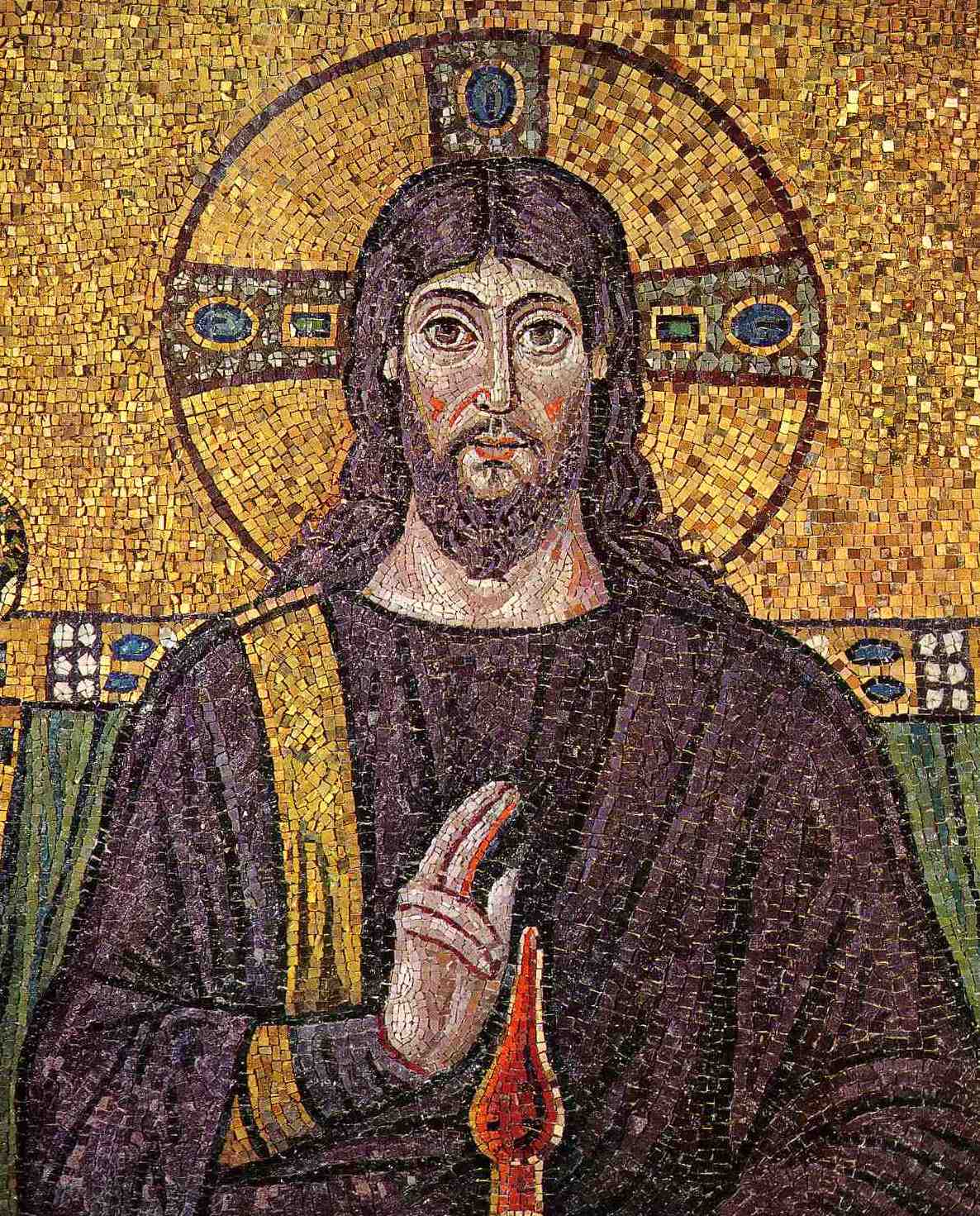
Sacred Heart of JesusSt. Paul provides some of the clearest and strongest biblical teachings on Purgatory.  In his first Epistle to the Corinthians Paul describes how each of us, after death, will be tested by fire:

For no other foundation can any one lay than that which is laid, which is Jesus Christ. Now if any one builds on the foundation with gold, silver, precious stones, wood, hay, straw — each man’s work will become manifest; for the day will disclose it, because it will be revealed with fire, and the fire will test what sort of work each one has done.  If the work which any man has built on the foundation survives, he will receive a reward. If any man’s work is burned up, he will suffer loss, though he himself will be saved, but only as through fire. (1 Corinthians 3:11-15)

The fire of loss is the fire of Hell. The saving fire is the purgative fire of Purgatory.  The purgative, saving fire brings a soul to full holiness; for “without holiness, no one will see the Lord” (Hebrews 12:14).   This is why a soul who desires to dwell with God and glorify God desires to be purified before seeing the face of the Lord.   A soul burden with the residuals of sin is encumbered in its ability to glorify God.  Through His infinite mercy, God purges the residuals of sin with fire and lovingly draws the soul in.

Oh, how our souls should yearn for the fire of Christ’s scared heart, a heart that burns with love and mercy!  Oh, to be consumed and purified by the fires of His heart.

Posted in Essays, Meditations On Biblical Verses, Uncategorized | Tagged , , , , , , , , , | 5 Comments

St. Catherine of Genoa on Purgatory

St. Catherine of GenoaSt. Catherine of Genoa was a mystic who influenced Saints John of the Cross, Francis de Sales, and Vincent de Paul. She also influenced the French Oratorian and Carmelite movements.  Near the end of her life St. Catherine wrote a treatise entitled On Purgation and Purgatory. In her treatise St. Catherine explains how Purgatory is an expression of God’s love for us and our love of God.

It is through love of God that a soul chooses Purgatory.  The soul desires to be purged of all the vestiges of sin that remain after death before approaching the throne of God to dwell in His presence and love.  Purgatory is where God, in all His mercy, removes all that hinders a soul from dwelling in His presence.  As the vestiges of sin are purged from the soul, that which hinders the loving embrace of God are removed.

It is through the soul’s desire to be intimately received by God that the soul joyfully submits to the purgation of Purgatory.  It is through God’s love and mercy that a soul is purified and refined in Purgatory so that it may dwell with God forever.

Posted in Essays, Uncategorized | Tagged , , , , , , , , | Leave a comment

What Held Christ to the Cross?

What Held Christ to the Cross?As I was prayerfully reflecting on my planned posting for today, which was to be on St. Catherine of Genoa and Purgatory, my prayer slowly drifted from St. Catherine and Purgatory to Christ Crucified and the question of “What held Christ to the cross?”  At first, I dismissed the question as a diversion.  However, the question persisted.

Then I dismissed the question as has having the obvious answer of: Christ was nailed to the cross.  Therefore, it was the nails that pierced his hands and feet that held Christ to the cross.

But, my heart said, “Yes, the nails did pierce his hands and feet. However, they did not hold Christ to the cross.  It was Christ’s obedience to His Father and love for us that held Him to the cross.”

In the back of mind I could hear the verse, “save yourself! If you are the Son of God, come down from the cross” (Matthew 27:40) juxtaposed with “This is my beloved Son, with whom I am well pleased” (Matthew 3:17).   Jesus is the Son of God.  He could have come down from the cross at any time.  But, He did not. He held Himself to cross.

It was His love for His Father that held Him to the cross.  It was His redeeming love for us that held Him to the cross.  So great is the love of Son for the Father, His Bride, the Church, and us!  Not only did Jesus lay Himself down to be nailed to the cross.  It was He, and not the nails that pierced His body, that held Him to the cross for those long agonizing hours.

Posted in Essays, Meditations On Biblical Verses, Uncategorized | Tagged , , , , , , , , | Leave a comment

Hail Full of Grace

Gabriel Greets Mary with "Hail Full of Grace"Upon what appears to be a simple greeting of “Hail Full of Grace”, salvation history turns.  According to Blessed Alan de la Roche the phrase is heavenly and beyond human understanding in its depth of meaning, it is an unheard of angelic greeting of reverence to a human being. Gabriel’s greeting of Mary is the only instance where an angelic messenger greets a human by title, rather than by name.

St. Thomas Aquinas posits that Gabriel’s greeting shows that Mary surpassed incorruptible spiritual angels in her dignity, in her close association with God, and in her fullness of grace.  Through this greeting God became man, a virgin becomes the Mother of God, the souls of just are delivered, the empty thrones in heaven are filled, sin is pardoned, grace is given to us, the sick become well, death is conquered, exiles come home, the Blessed Trinity is appeased, and humanity obtains eternal life (St. Louis Marie de Montfort).

The greeting “Hail full of Grace” is an indicator of Mary’s lifelong holiness and her important role in salvation history.

Posted in Essays, Meditations On Biblical Verses, Uncategorized | Tagged , , , , , , , , , , , | 2 Comments

The Sign of Cross and St. Francis De Sales

The Sign of Cross & St. Francis De SalesI had commented in a previous posting to what I perceived as a decline in baptized Catholics making the Sign of the Cross.  I recently read St. Francis De Sales on the Sign of the Cross.  He teaches that as Christians we represent in a simple motion the Passion of Christ by tracing the Sign of the Cross.  The Sign is also a public profession of our faith.  Some who see Christ and His Cross as shame, folly and a fantasy may mock us for making the Sign of the Cross.  Upon the cross Christ abased Himself and subjected Himself to death. To a Christian, the Sign of the Cross is employed to give honor to the ultimate sacrifice offered by Christ Jesus.

The Sign of the Cross is also a defense against demons.  It is invincible armor against the Evil One.  According to St. Francis De Sales the Sign of Cross is a helmet to defend the head, a breastplate to preserve the chest, a buckler to repel the arrows of the Evil One, and a sword to defend against diabolical tricks.

The Sign of the Cross, according to St. Francis De Sales, is a brief and powerful invocation to Jesus Christ, our Redeemer, which can be employed at any time and for any occasion. Ultimately, our glory lies in the cross and Christ crucified.  This is why we mark ourselves, and all occasions with the Cross.

Posted in Essays, Uncategorized | Tagged , , , , , , | 1 Comment

St. Thérèse on Approaching God

St. Thérèse at 13 years

St. Thérèse at 13 years

More fearful than standing before a large audience to deliver a speech, is standing before God.  We fear being found unworthy and sinful.  We need only look to the Gospels to dispel our fears.  Christ welcomed all to approach who felt unworthy because of their state in life or sinfulness.   They need only call out His name or beg His mercy to approach and be healed.

St. Thérèse teaches that we should have complete trust in the merciful love of Jesus.  His divine heart is irresistibly inclined to pour out its mercy without measure on the abject and the lowly.

We are to approach Christ in “trustful humility” with our sinfulness, brokenness, and imperfections before us.  Through His mercy our sins will be forgiven, our brokenness healed, and our imperfections refined.

In “trustful humility” we should offer ourselves as an “empty vessel” to be filled with the love of God and ultimately absorbed in love in Him.     We should never fear His loving mercy.  We should approach unhindered, to embrace His merciful love.

Posted in Essays | Tagged , , , , , , , , , | 3 Comments

Christ the Pruner

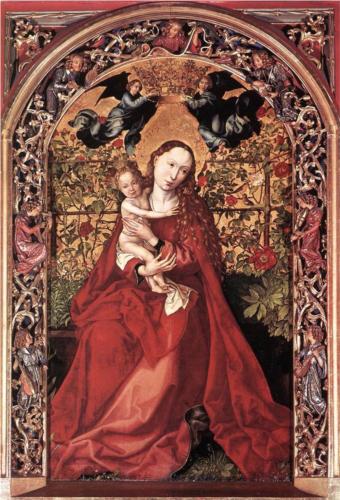
Madonna of the Rose Bush

Madonna of the Rose Bush

Today was hot and humid.  My task was to prune the dead blooms from our rose bushes.  As I moved from one bush to another, my mind drifted to “he prunes, that it may bear more fruit” (John 15:2).  As I pruned the dead blooms from the bushes, so that they would bloom again in beautiful splendor, I though of how Christ prunes me so that I may bloom through His grace.

Why do I run from His pruning shears?  Him prunes in love.  He prunes me so that I may show forth His glory and bare fruit in His name.

Posted in Essays, Meditations On Biblical Verses, Uncategorized | Tagged , , , , , , , | Leave a comment